Spacetime in Geometric Algebra
The right way to look at
Spacetime and Maxwell's Equations
(or should I say "equation")
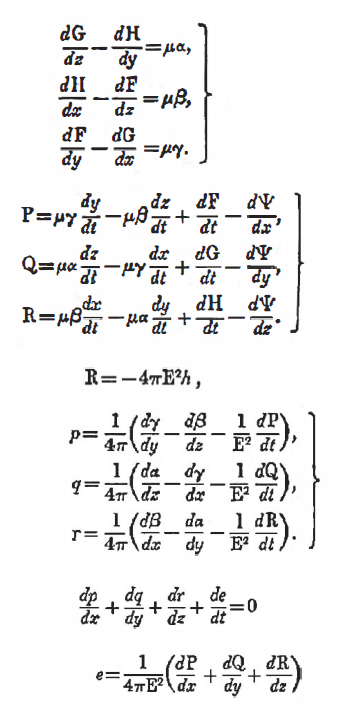
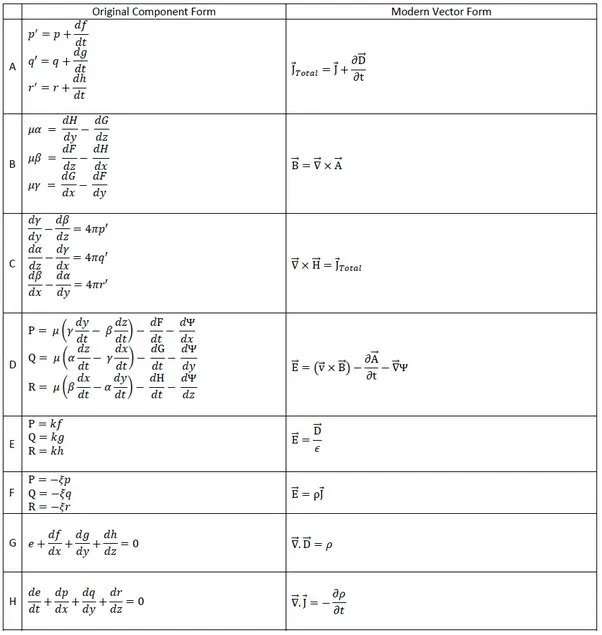
Not so much taught at school, but there is a 4-dimensional version
The 4-vectors:Potential \(A_\mu=(\phi, -\overrightarrow{A})\) Charge \(J^\mu=(\rho, \overrightarrow{J})\) Differential \(\partial_\mu=\frac{\partial}{\partial x^\nu}=(\frac{\partial}{\partial t}, \overrightarrow{\nabla})= (\frac{\partial}{\partial t}, \frac{\partial}{\partial x}, \frac{\partial}{\partial y}, \frac{\partial}{\partial z})\)
Define the rank-2 4-formFaraday field \(F_{\mu\nu}= \partial_\mu A_\nu - \partial_\nu A_\mu=\) \[= \begin{bmatrix} 0 & \frac{\partial \phi}{\partial x} + \frac{\partial A_x}{\partial t} & \frac{\partial \phi}{\partial y} + \frac{\partial A_y}{\partial t} & \frac{\partial \phi}{\partial z} + \frac{\partial A_z}{\partial t} \\ -\frac{\partial \phi}{\partial x} - \frac{\partial A_x}{\partial t} & 0 & -\frac{\partial A_x}{\partial y} + \frac{\partial A_y}{\partial x} & -\frac{\partial A_z}{\partial x} + \frac{\partial A_x}{\partial z} \\ -\frac{\partial \phi}{\partial y} - \frac{\partial A_y}{\partial t} & \frac{\partial A_y}{\partial x} - \frac{\partial A_x}{\partial y} & 0 & -\frac{\partial A_z}{\partial y} + \frac{\partial A_y}{\partial z}\\ -\frac{\partial \phi}{\partial z} - \frac{\partial A_z}{\partial t} & \frac{\partial A_z}{\partial x} - \frac{\partial A_x}{\partial z} & \frac{\partial A_z}{\partial y} - \frac{\partial A_y}{\partial z} & 0 \end{bmatrix}= \begin{bmatrix} 0 & -E_x & -E_y & -E_y \\ E_x & 0 & -B_z & B_y \\ E_y & B_z & 0 & =B_x\\ E_z & -B_y & B_x & 0 \end{bmatrix} \]
And the Dual field \(F^*_{\alpha\beta}=\frac{1}{2}\epsilon_{\alpha\beta\gamma\delta} F^{\gamma\delta}\)
The final 2 Maxwell's equations: \[DF=J\]\[DF^*=0\]
Introduction
The original Maxwell's equations are often seen as complex and unintuitive.
Compare with the equations that we currently teach in school. More modern formulations that are more compact and elegant.
\[\overrightarrow{\nabla} \cdot \overrightarrow{E} = \frac{\rho}{\epsilon_0}\]
\[\overrightarrow{\nabla} \cdot \overrightarrow{B} = 0\]
\[\overrightarrow{\nabla} \times \overrightarrow{E} = - \frac{\partial \overrightarrow{B}}{\partial t}\]
\[\overrightarrow{\nabla} \times \overrightarrow{B} = \mu_0 \overrightarrow{J} + \mu_0 \epsilon_0 \frac{\partial \overrightarrow{E}}{\partial t}\]
and some more.
\[\frac{\partial \rho}{\partial t} + \overrightarrow{\nabla} \cdot \overrightarrow{J} = 0\]
\[\overrightarrow{B} = \overrightarrow{\nabla} \times \overrightarrow{A} \qquad \overrightarrow{E} = -\overrightarrow{\nabla} \phi - \frac{\partial \overrightarrow{A}}{\partial t}\]
The final 2 Maxwell's equations: \[DF=J\]\[DF^*=0\]
This is not just a mathematical trick. It reveals the underlying geometric structure of electromagnetism and spacetime.
We use Vectors, but we also multiply them. So this is more than a vector space, it is an Algebra, a Geometric Algebra.
\[\overrightarrow{\nabla} \cdot \overrightarrow{E} = \frac{\rho}{\epsilon_0}\]
\[\overrightarrow{\nabla} \times \overrightarrow{B} - \mu_0 \epsilon_0 \frac{\partial \overrightarrow{E}}{\partial t}= \mu_0 \overrightarrow{J}\]
\[\overrightarrow{\nabla} \cdot \overrightarrow{B} = 0\]
\[\overrightarrow{\nabla} \times \overrightarrow{E} + \frac{\partial \overrightarrow{B}}{\partial t} = 0\]
Geometric Algebra
Space Algebra
An algebra is a vector space with a multiplication \(W=VU\)
Associative? \((ab)c=a(bc)\), Commutative? \(ab=ba\), Distributive? \((a+b)c=ac+bc\)
Add multiplication to a vector space \(e_1,e_2, e_3\)
We want \(e_ie_i\) to be a multiplication scalar (marked as 1), and a new member of the algebra
We actually want any combination VV to ba a scalar
This leads to \(e_1e_2=-e_2e_1\)
But \(e_1e_2\) is a new member of the algebra,define \(e_{12}\equiv e_1e_2\)
Also from \(e_1 e_{23}\) we get \(e_{123}\)
Mechanism of Space Algebra Multiplication
Let's practice some simple multiplications
\[e_{12}e_{23} = e_{13} = - e_{31}\]
\[e_{23}e_{13} = -e_{23}e_{31} = - e_{21} = e_{12}\]
\[e_{31}e_{123} = e_{3}e_{23} = - e_{2}\]
And also complex multiplications
\[(\alpha e_{1} + \beta e_{12})(\gamma e_{3} + \delta e_{23}) =\]
\[= \alpha \gamma e_{1}e_{3} + \alpha \delta e_{1}e_{23} + \beta \gamma e_{12}e_{3} + \beta \delta e_{12}e_{23} = \]
\[= (\alpha \gamma + \beta \delta) e_{13} + (\alpha \delta + \beta \gamma) e_{123}\]
The product of two vectors A and B
\[AB =(A_1 e_1 + A_2 e_2 + A_3 e_3)(B_1 e_1 + B_2 e_2 + B_3 e_3) = \]
\[= (A_1 B_1 + A_2 B_2 + A_3 B_3) 1 + \]
\[+ (A_1 B_2 - A_2 B_1) e_{12} + (A_2 B_3 - A_3 B_2) e_{23} + (A_3 B_1 - A_1 B_3) e_{31}\]
Symmetric and antisymmetric parts
\[\overrightarrow{A} \overrightarrow{B}=\overrightarrow{A} \cdot \overrightarrow{B} + \overrightarrow{A} \wedge \overrightarrow{B}\]
\[(\overrightarrow{A} \times \overrightarrow{B} = - I (\overrightarrow{A} \wedge \overrightarrow{B}))\]
What is multiplied here?
Space Algebra Representation
| 1 | 0 |
| 0 | 1 |
| 0 | 1 |
| 1 | 0 |
| 0 | -i |
| i | 0 |
| 1 | 0 |
| 0 | -1 |
| i | 0 |
| 0 | -i |
| 0 | i |
| i | 0 |
| 0 | 1 |
| -1 | 0 |
| i | 0 |
| 0 | i |
Spacetime Algebra
Good for representing spacetime physics, including Maxwell's equations
| 1 | 0 |
| 0 | 1 |
| i | 0 |
| 0 | -i |
| 0 | |
| 0 |
| 0 | |
| 0 |
| 0 | |
| 0 |
| 0 | |
| 0 |
| 0 | |
| 0 |
| 0 | |
| 0 |
| 0 | |
| 0 |
| 0 | |
| 0 |
| 0 | |
| 0 |
| 0 | -1 |
| 1 | 0 |
| 0 | |
| 0 |
| 0 | |
| 0 |
| 0 | |
| 0 |
| 0 | -i |
| -i | 0 |
Electromagnetic Field Equation
The simplest spacetime theory
Start with a vector \(A\)
Differenciate it \(\nabla A=F\) to get the electromagnetic field bivector
Differentiate that \(\nabla F = J\) to get the source vector
\(\nabla F = J\) is the one and only Maxwell's equation
The Electromagnetic Field
\(A=(A_0, \overrightarrow{A}) = e_0 A_0 + e_1 A_1 + e_2 A_2 + e_3 A_3\)
\(\nabla=(e_0 \frac{\partial}{\partial t}, \overrightarrow{\nabla}) = e_0 \frac{\partial}{\partial t} + e_1 \frac{\partial}{\partial x} + e_2 \frac{\partial}{\partial y} + e_3 \frac{\partial}{\partial z}\)
\[ \definecolor{lRed}{RGB}{255, 120, 120} \definecolor{lBlue}{RGB}{100, 180, 255} F = \nabla A = \begin{matrix} \color{green} e_0 e_0 \frac{\partial A_0}{\partial t} & + \color{lRed} e_0 e_1 \frac{\partial A_1}{\partial t} & + \color{lRed} e_0 e_2 \frac{\partial A_2}{\partial t} & + \color{lRed} e_0 e_3 \frac{\partial A_3}{\partial t} \\ + \color{lBlue} e_1 e_0 \frac{\partial A_0}{\partial x} & + \color{green} e_1 e_1 \frac{\partial A_1}{\partial x} & +\color{lRed} e_1 e_2 \frac{\partial A_2}{\partial x} & + \color{lBlue} e_1 e_3 \frac{\partial A_3}{\partial x} \\ + \color{lBlue} e_2 e_0 \frac{\partial A_0}{\partial y} & + \color{lBlue} e_2 e_1 \frac{\partial A_1}{\partial y} & + \color{green} e_2 e_2 \frac{\partial A_2}{\partial y} & + \color{lRed} e_2 e_3 \frac{\partial A_3}{\partial y} \\ + \color{lBlue} e_3 e_0 \frac{\partial A_0}{\partial z} & + \color{lRed}e_3 e_1 \frac{\partial A_1}{\partial z} & + \color{lBlue} e_3 e_2 \frac{\partial A_2}{\partial z} & + \color{green} e_3 e_3 \frac{\partial A_3}{\partial z} \end{matrix}\]
\( -{\color{green}\frac{\partial A_0}{\partial t}} + {\color{green}\frac{\partial A_1}{\partial x}} + {\color{green}\frac{\partial A_2}{\partial y}} + {\color{green}\frac{\partial A_3}{\partial z}} = -\dot{A_0} + \nabla \cdot A = 0\) (Lorentz condition)
\( e_0 e_1 \left({\color{lRed}\frac{\partial A_1}{\partial t}} - \color{lBlue}\frac{\partial A_0}{\partial x}\right) + e_0 e_2 \left({\color{lRed}\frac{\partial A_2}{\partial t}} - \color{lBlue}\frac{\partial A_0}{\partial y}\right) + e_0 e_3 \left({\color{lRed}\frac{\partial A_3}{\partial t}} - \color{lBlue}\frac{\partial A_0}{\partial z}\right) + e_1 e_2 \left({\color{lRed}\frac{\partial A_2}{\partial x}} - \color{lBlue}\frac{\partial A_1}{\partial y}\right) + e_1 e_3 \left({\color{lRed}\frac{\partial A_3}{\partial x}} - \color{lBlue}\frac{\partial A_1}{\partial z}\right) + e_2 e_3 \left({\color{lRed}\frac{\partial A_3}{\partial y}} - \color{lBlue}\frac{\partial A_2}{\partial z}\right) \)
\[F = e_0 e_1 E_x + e_0 e_2 E_y + e_0 e_3 E_z + e_1 e_2 B_x + e_1 e_3 B_y + e_2 e_3 B_z\]
\[\overrightarrow{E}= \frac{\partial \overrightarrow{A}}{\partial t} - \overrightarrow{\nabla}A_0\quad \overrightarrow{B} = \overrightarrow{\nabla} \times \overrightarrow{A}\]
The Field Equation
\[F = e_0 e_1 E_x + e_0 e_2 E_y + e_0 e_3 E_z + e_1 e_2 B_x + e_1 e_3 B_y + e_2 e_3 B_z\]
\[ \definecolor{lRed}{RGB}{255, 120, 120} \definecolor{lBlue}{RGB}{100, 180, 255} \nabla F = \begin{matrix} e_0 e_0 e_1 \frac{\partial E_x}{\partial t} & e_0 e_0 e_2 \frac{\partial E_y}{\partial t} & e_0 e_0 e_3 \frac{\partial E_z}{\partial t} & e_0 e_2 e_3 \frac{\partial B_x}{\partial t} & e_0 e_3 e_1 \frac{\partial B_y}{\partial t} & e_0 e_1 e_2 \frac{\partial B_z}{\partial t} \\ \color{yellow} e_1 e_0 e_1 \frac{\partial E_x}{\partial x} & e_1 e_0 e_2 \frac{\partial E_y}{\partial x} & e_1 e_0 e_3 \frac{\partial E_z}{\partial x} & \color{red} e_1 e_2 e_3 \frac{\partial B_x}{\partial x} & e_1 e_3 e_1 \frac{\partial B_y}{\partial x} & e_1 e_1 e_2 \frac{\partial B_z}{\partial x} \\ e_2 e_0 e_1 \frac{\partial E_x}{\partial y} & \color{yellow} e_2 e_0 e_2 \frac{\partial E_y}{\partial y} & e_2 e_0 e_3 \frac{\partial E_z}{\partial y} & e_2 e_2 e_3 \frac{\partial B_x}{\partial y} & \color{red} e_2 e_3 e_1 \frac{\partial B_y}{\partial y} & e_2 e_1 e_2 \frac{\partial B_z}{\partial y} \\ e_3 e_0 e_1 \frac{\partial E_x}{\partial z} & e_3 e_0 e_2 \frac{\partial E_y}{\partial z} & \color{yellow} e_3 e_0 e_3 \frac{\partial E_z}{\partial z} & e_3 e_2 e_3 \frac{\partial B_x}{\partial z} & e_3 e_3 e_1 \frac{\partial B_y}{\partial z} & \color{red} e_3 e_1 e_2 \frac{\partial B_z}{\partial z} \\ \end{matrix}\]
\[ e_0\left(\color{yellow}\frac{\partial E_x}{\partial x} + \frac{\partial E_y}{\partial y} + \frac{\partial E_z}{\partial z}\color{black}\right) + e_1\left(-\frac{\partial E_x}{\partial t} + \frac{\partial B_z}{\partial y} - \frac{\partial B_y}{\partial z}\right) + e_2\left(-\frac{\partial E_y}{\partial t} + \frac{\partial B_x}{\partial z} - \frac{\partial B_z}{\partial x}\right) + e_3\left(-\frac{\partial E_z}{\partial t} + \frac{\partial B_y}{\partial x} - \frac{\partial B_x}{\partial y}\right) \] \[\overrightarrow{\nabla}\cdot\overrightarrow{E} + \left(\overrightarrow{\nabla}\times\overrightarrow{B}- \frac{\partial \overrightarrow{E}}{\partial t}\right)= J = \left(\rho, \overrightarrow{J}\right)\]
\[ e_{123}\left(\color{red}\frac{\partial B_x}{\partial x} + \frac{\partial B_y}{\partial y} + \frac{\partial B_z}{\partial z}\color{black}\right) + e_{230}\left(-\frac{\partial B_x}{\partial t} + \frac{\partial E_y}{\partial z} - \frac{\partial E_z}{\partial y}\right) + e_{301}\left(-\frac{\partial B_y}{\partial t} + \frac{\partial E_z}{\partial z} - \frac{\partial E_x}{\partial x}\right) + e_{012}\left(-\frac{\partial B_z}{\partial t} + \frac{\partial E_x}{\partial x} - \frac{\partial E_y}{\partial y}\right) \] \[\overrightarrow{\nabla}\cdot\overrightarrow{B} + \left(\overrightarrow{\nabla}\times\overrightarrow{E}+ \frac{\partial \overrightarrow{B}}{\partial t}\right)= 0\]
The Lorentz Condition
\( \nabla A = \nabla \cdot A + \nabla \wedge A\)
\( \nabla \cdot A = -{\color{green}\frac{\partial A_0}{\partial t}} + {\color{green}\frac{\partial A_1}{\partial x}} + {\color{green}\frac{\partial A_2}{\partial y}} + {\color{green}\frac{\partial A_3}{\partial z}}\)
Assume \(\nabla \cdot A = \theta \neq 0\).
Solve \(\nabla^2 \chi = \theta\). Solution always exists.
A new potential \(A' = A - \nabla \chi\). This doesn't change \(F\) since \(\nabla \wedge \nabla \chi = 0\).
It does change the divergence: \(\nabla \cdot A' = \nabla \cdot A - \nabla^2 \chi = \theta - \theta = 0\).
Thank you